
Generation of Knowledge Assets in the
Valle de la Lengua Data Space
USE CASE
Knowledge exists.
The problem is how to make the most of it.
The Institute for Occupational Safety and Wellbeing (ISBL) is an organisation specialising in training, occupational risk prevention, industrial safety, auditing, certification, management systems and organisational wellbeing.
Over the years, ISBL has built up a vast documentary archive comprising teaching materials, technical manuals, work procedures, methodological guides, training programmes, question banks for assessment, content for technical dissemination and supporting documentation for consultancy and certification.
In addition to this in-house collection, there is an extensive range of public sources regularly used by its specialists, including technical documentation from the National Institute for Occupational Safety and Health (INSST), national and international regulations, ministerial guidelines, documents from public bodies and specialist technical publications.
All this knowledge constitutes one of the organisation’s most valuable assets.
However, there is a problem.
Every time a technician needs to develop a new course, prepare teaching materials, create an exam, draft a procedure, produce a practical guide or create informative content for LinkedIn, they must locate documents, review information, check versions, select relevant content and manually adapt the result to the specific context of use.
Knowledge exists.
Information exists.
Experience exists.
But re-use still relies heavily on manual work.
It is precisely this problem that the Valle de la Lengua Data Space aims to solve.
The ‘Knowledge Asset Generation’ use case demonstrates how the Valle de la Lengua Data Space can transform large volumes of Spanish-language documentation into structured knowledge through interoperability, semantic processing and generative artificial intelligence, connecting participants via the CODICE service. The model enables different participants to publish, identify and consume data services securely and in a traceable manner, whilst retaining sovereignty over their assets and technological infrastructure. The Valle de la Lengua Data Space acts as a trusted infrastructure that ensures governance, interoperability and the exchange of services between organisations. Its approach enables scattered information to be converted into useful, reusable and contextualised knowledge. Furthermore, it validates, in a real-world environment, the European principles of federated data spaces as applied to the Spanish-language ecosystem.
The first tangible evidence of the ecosystem’s value becomes apparent even before the knowledge is incorporated. CÓDICE utilises the governance infrastructure of the Valle de la Lengua Data Space and is capable of managing participants, organisations, permissions, artificial intelligence models, document templates and common operating policies for all stakeholders in the ecosystem.
The stakeholders in the ecosystem
The use case centres on three organisations with different but complementary needs.
CÓDICE acts as the element that connects them all.
Through this infrastructure, each organisation has its own identity, specific permissions and distinct capabilities within the ecosystem.
ISBL transforms its knowledge into a digital asset
The management of ISBL takes a strategic decision.
Rather than using its documentation solely as an internal repository, it decided to turn it into a reusable asset within the Valle de la Lengua Data Space.
To do this, it logs into CÓDICE using a supplier profile.
From this environment, it creates a new topic entitled:
‘Occupational Health and Safety’
This topic will serve as the space in which all knowledge relating to this subject will be organised.
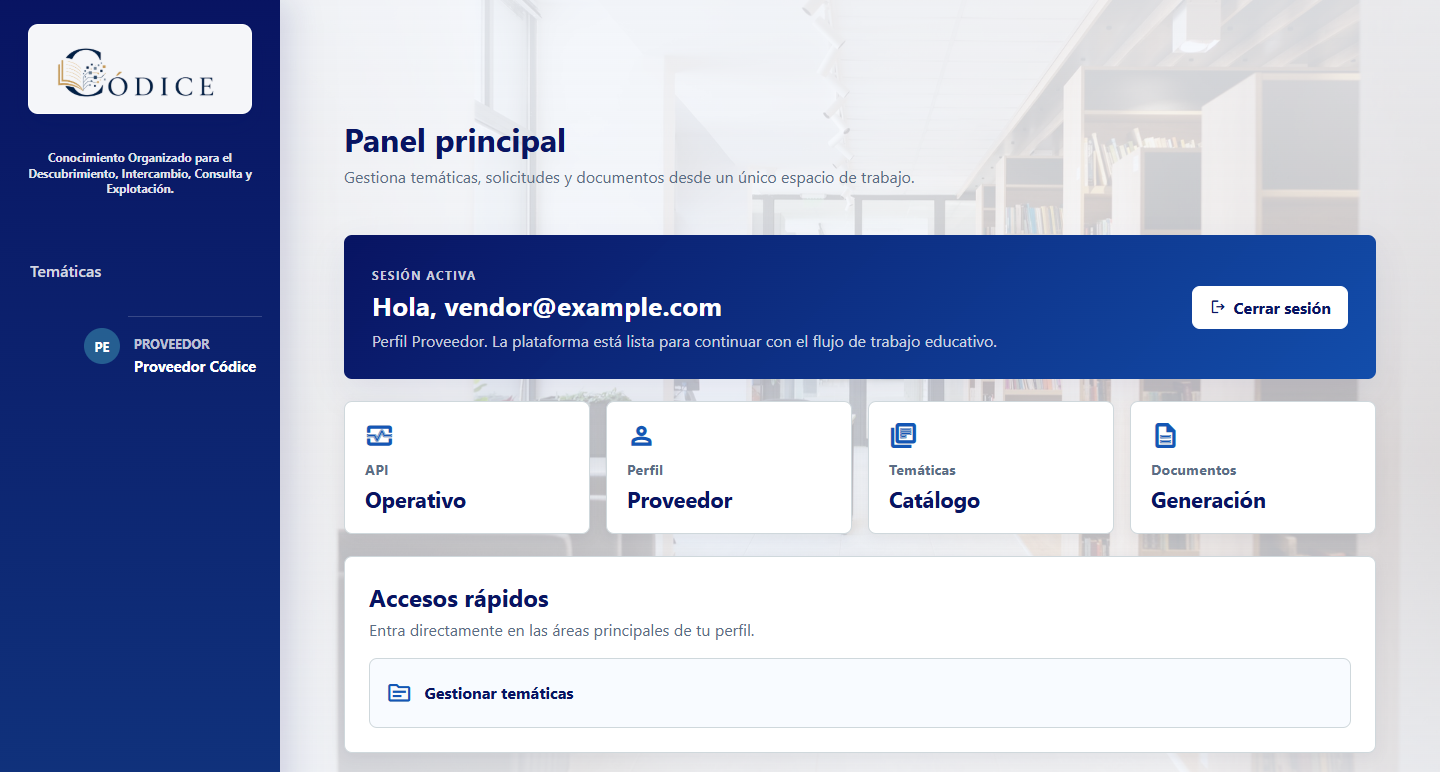
The system allows users to create new topics, manage them and control their visibility within the ecosystem. ISBL specialists then begin to add knowledge. They do not simply upload documents; they build a structured knowledge base.
The following are added:
Prevention manuals
Teaching programmes
Technical guides
Operating procedures
Training materials
Case studies
Exams
Audiovisual resources
Regulations
INSST Guides
Specialist publications
Each topic includes descriptive information, academic level, target audience, category and metadata, which will subsequently facilitate the intelligent use of the content.
Once the documents have been uploaded, the topic is published.
From that point onwards, it ceases to be a private collection of files and becomes a knowledge asset available to other authorised participants.
First scenario:
ISBL draws on its own expertise
The organisation needs to organise a new training programme
for senior health and safety officers.
Traditionally, the teaching team would have spent several days gathering documentation, selecting content, preparing teaching materials and designing assessment activities.
Now the process is different.
Academic staff log into the Data Hub as users.
They locate the published topic.
They activate it.
And they request the generation of content.
Second scenario:
ISBL Mexico
ISBL Mexico is one of the clearest examples of the value provided by the Data Space.
The organisation runs training programmes in Latin America and needs to reuse the expert knowledge generated by ISBL Spain.
Before CÓDICE existed, this involved exchanging documents, checking versions, coordinating teams and manually adapting content.
Now the process has been radically simplified.
ISBL Mexico accesses the catalogue of published assets.
It selects the relevant topic.
It requests the creation of new materials.
And it receives content based on the same expert knowledge used by the parent organisation.
The results may include:
Manuals tailored to the Latin American market
Corporate training materials
Exams
Case studies
Guides for teachers
Technical articles
Posts for LinkedIn
Social media content
All this whilst maintaining methodological and documentary consistency between the two organisations.
Scenario three:
Danica Developers
Danica Desarrollos is a company specialising in engineering and technological development.
The organisation needs to provide regular training for its staff on matters relating to health and safety, operational procedures, good industrial practice and regulatory compliance.
However, Danica’s requirements are very specific.
The generic materials available on the market do not adequately address its internal processes or organisational characteristics.
For this reason, Danica has entered into an agreement with ISBL.
This agreement allows it to access certain topics published within the Data Space.
From that point onwards, Danica can use the expert knowledge developed by ISBL as a primary source to generate fully customised materials.
Training managers log into the system, describe their needs and request the creation of specific documentation.
The results obtained may include:
Induction handbooks
Internal procedures
Work instructions
Safety guidelines
Training programmes
E-learning materials
Competency assessments
Internal awareness-raising campaigns
All of this is based on expert knowledge that has been previously validated by specialists.
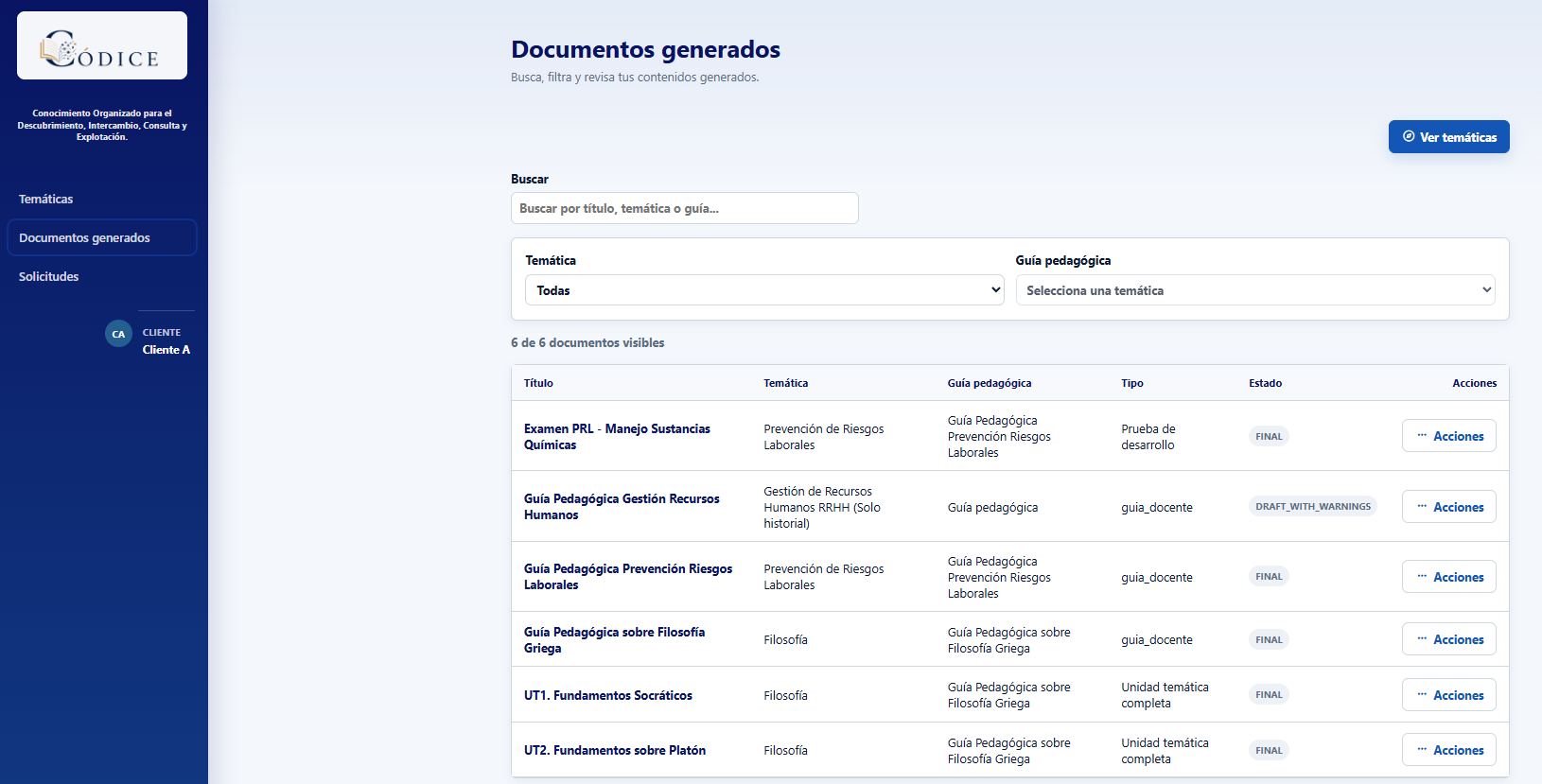
The true value of CÓDICE
At first glance, it might seem that the system simply generates documents.
However, the true value of this use case runs much deeper.
CÓDICE enables specialised knowledge to be transformed into a reusable digital asset.
It allows an organisation to publish capabilities without losing control over its assets.
It allows other organisations to discover, contract and utilise those capabilities.
It enables the traceability of all operations to be maintained.
It enables knowledge to be reused systematically.
It enables services to be scaled across different countries and organisations.
It enables artificial intelligence to work on validated and governed knowledge.
In short, Use Case demonstrates how the Data Space Valle de la Lengua can become a genuine infrastructure for knowledge transfer, collaboration between organisations and the generation of economic value from specialised documentary assets.