
Generation of Knowledge Assets at
Valle de la Lengua Data Space
USE CASE
THE PROBLEM
Knowledge exists.
The problem is how to make use of it.
Over the years, ISBL has built up a vast body of specialized knowledge in safety, prevention, training, and workplace well-being, backed by thousands of documents, methodologies, and technical resources.
In addition to this in-house knowledge, external reference sources—such as national and international regulations, technical documentation, and specialized publications—are integral to the daily work of its professionals.
However, accessing the right information, locating it among multiple sources, and adapting it to specific needs remains a time-consuming and labor-intensive process.
Knowledge exists.
Information exists.
Experience exists.
But reuse still depends largely on manual work.
It is precisely this problem that the Valle de la Lengua Data Hub aims to solve.
The “Knowledge Asset Generation” use case demonstrates how the Valle de la Lengua Data Space can transform large volumes of Spanish-language documentation into structured knowledge through interoperability, semantic processing, and generative artificial intelligence, connecting participants via the CODICE service. The model enables different participants to publish, identify, and consume data services in a secure and traceable manner, while maintaining sovereignty over their assets and technological infrastructure.
The Valle de la Lengua Data Space acts as a trusted infrastructure that ensures governance, interoperability, and the exchange of services among organizations. Its approach makes it possible to convert scattered information into useful, reusable, and contextualized knowledge. Furthermore, it validates, in a real-world environment, the European principles of federated data spaces as applied to the Spanish-language ecosystem.
The first evidence of the ecosystem’s value appears even before knowledge is incorporated. CODICE utilizes the Valle de la Lengua Data Space’s governance infrastructure and is capable of managing participants, organizations, permissions, artificial intelligence models, document templates, and common operating policies for all actors in the ecosystem.
Stakeholders in the Ecosystem
The use case revolves around three organizations with different but complementary needs.
CÓDICE serves as the element that connects them all.
Through this infrastructure, each organization has its own identity, specific permissions, and distinct capabilities within the ecosystem.
ISBL transforms its knowledge into a digital asset
ISBL's management makes a strategic decision.
Instead of using its documentation solely as an internal repository, it decides to turn it into a reusable asset within the Valle de la Lengua Data Space.
To do so, it logs into CÓDICE with a provider profile. From this environment, it creates a new topic called: “Occupational Risk Prevention and Industrial Safety.”
This topic will serve as the space where all knowledge related to this subject will be organized.
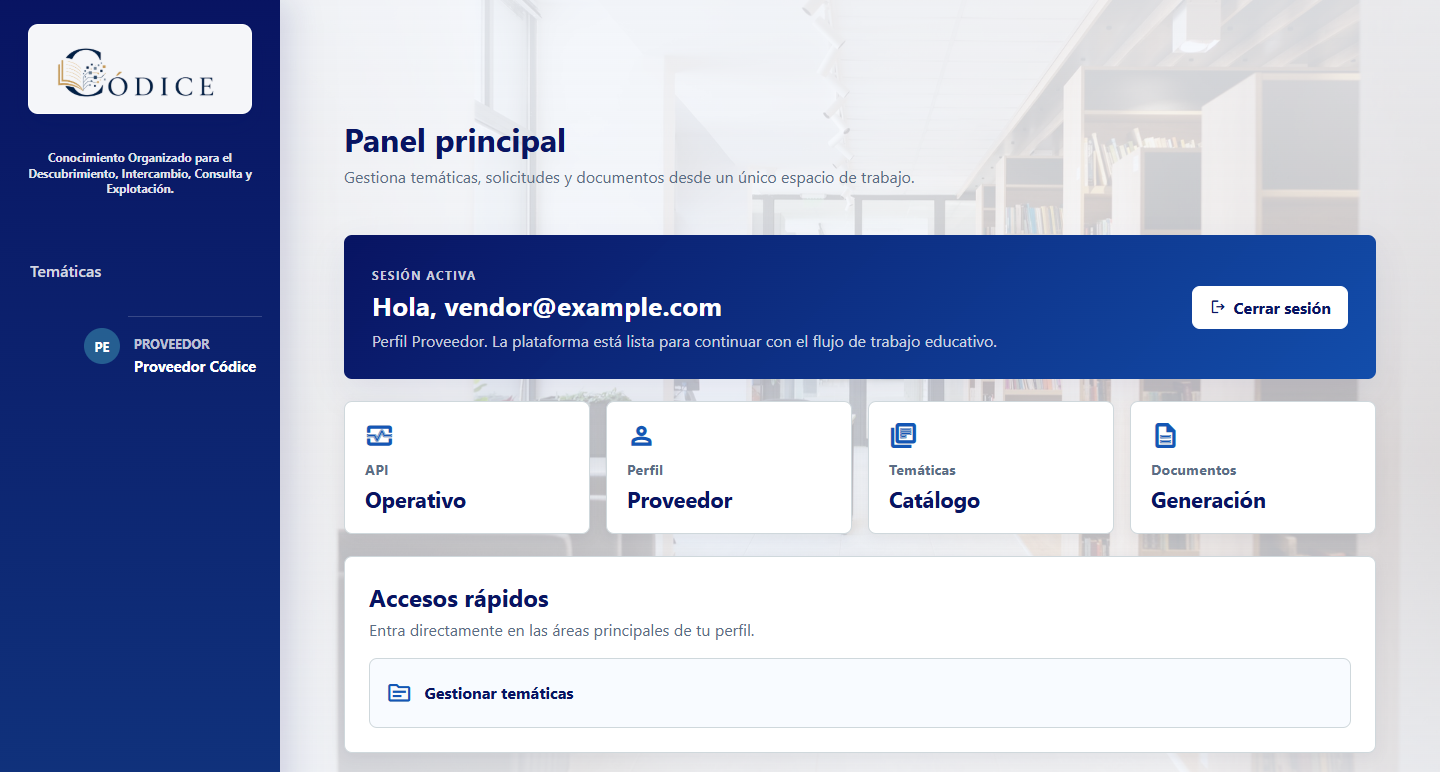
The system allows you to create new topics, manage them, and control their visibility within the ecosystem.
Next, ISBL specialists begin to incorporate knowledge. They don’t just upload documents; they build a structured knowledge base.
The following are incorporated:


Each topic includes descriptive information, academic level, target audience, category, and metadata that will subsequently facilitate the intelligent use of the content.
Once the documents have been uploaded, the topic is published.
From that point on, it ceases to be a private collection of files and becomes a knowledge asset available to other authorized participants.
FIRST SCENARIO
ISBL draws on its own expertise
El primer consumidor de los activos publicados es el propio ISBL.
La organización necesita preparar una nueva acción formativa
para técnicos superiores de prevención.
Tradicionalmente, el equipo docente habría invertido varios días recopilando documentación, seleccionando contenidos, elaborando material didáctico y diseñando actividades de evaluación.
Ahora el proceso es diferente.
SECOND SCENARIO
ISBL Mèxic
ISBL Mexico is one of the clearest examples of the value provided by the Data Space.
The organization conducts training activities in Latin America and needs to reuse expert knowledge generated by ISBL Spain.
Before CÓDICE existed, this involved exchanging documents, verifying versions, coordinating teams, and manually adapting content.
Now the process is radically simplified.
The results may include:
Manuals tailored to the Latin American market
Corporate training materials
Exams
Case studies
Teacher's guides
Technical articles
LinkedIn posts
Social media content
All of this while maintaining methodological and documentary consistency between the two organizations.
Scenario Three
Danica Desarrollos
Danica Desenvolupaments és una empresa especialitzada en desenvolupament d'enginyeria i tecnològic.
L'organització necessita oferir formació regular al seu personal sobre qüestions relacionades amb la salut i la seguretat, els procediments operatius, les bones pràctiques industrials i el compliment normatiu.
No obstant això, els requisits de Danica són molt específics.
Els materials genèrics disponibles al mercat no aborden adequadament els seus processos interns ni les seves característiques organitzatives.
Per aquest motiu, Danica ha signat un acord amb ISBL.
Aquest acord li permet accedir a temes específics publicats a l'espai de dades.
A partir d'aleshores, Danica pot utilitzar els coneixements experts desenvolupats per ISBL com a font principal per generar materials totalment personalitzats.
Els responsables de formació iniciïn sessió al sistema, descriguin les seves necessitats i sol·licitin la creació de documentació específica.
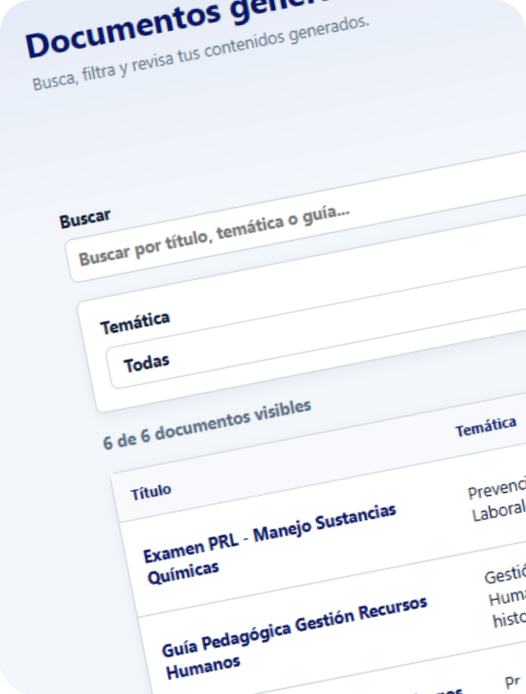
Knowledge can be transformed into:
Onboarding manuals
Internal procedures
Work instructions
Safety guides
Training programs
E-learning materials
Competency assessments
Internal awareness campaigns
All of this is based on expert knowledge that has been previously validated by specialists.
The True Value of CÓDICE
At first glance, it might seem that the system simply generates documents. However, the true value of this use case runs much deeper.
In short, the use case demonstrates how the Valle de la Lengua Data Space can become a tangible infrastructure for knowledge transfer, collaboration among organizations, and the generation of economic value from specialized documentary assets.